Study in Australia: complete guide for international students
Updated: April 2026
When considering Australia as your study destination, there's a lot to think about – is Australia the right fit for me? Which city should I move to? and How will I find work? may be some of the questions on your mind.
At KBS, you have the unique opportunity to choose from six campus locations – Adelaide, Brisbane, Gold Coast, Melbourne, Perth and Sydney – with the option to transfer campuses if you ever consider a move in the future.
To help with your research, we’ve created a free ebook that will take you through all the valuable information you need to know about studying in Australia, including:
- Pre-arrival checklists
- Settling in on arrival
- Top facts and perks for the capital cities of Adelaide, Brisbane, Gold Coast, Melbourne, Perth and Sydney
THINKING OF STUDYING IN AUSTRALIA?
Here’s the information you need from planning to arrival.
Or continue reading for more information on what you need to know:
ABOUT AUSTRALIA
Australia has developed a strong global reputation as a popular and rewarding study destination due to its excellent education system, high standard of living, friendly community, laid-back lifestyle and vibrant city life.
Whether you're chasing the buzz of living in a large, metropolitan city or prefer a more laid-back, smaller city that offers amazing outdoor adventures, Australia has the right place for you.
TOP REASONS TO STUDY IN AUSTRALIA
There are many great reasons to study abroad and here are 6 top benefits of choosing Australia as your destination.
1. Unforgettable sights and natural beauty
Australia’s stunning natural beauty and unique flora and wildlife are world-renowned.
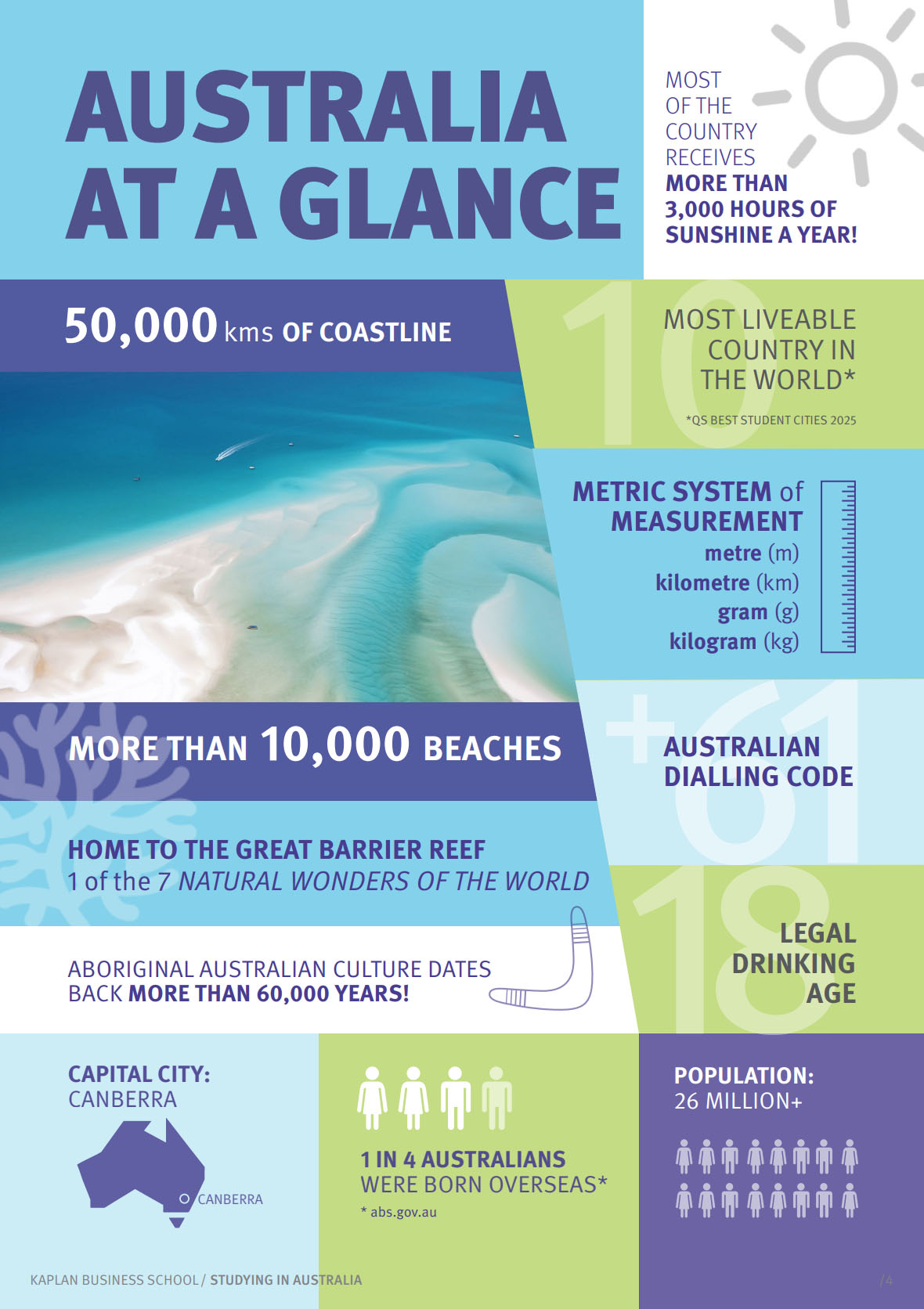
There are over 11,000 beaches along the coastline. You’ll be able to visit iconic landmarks including the Sydney Harbour Bridge, Opera House, and Bondi Beach, learn about Aboriginal culture and heritage in Uluru, and explore a diverse range of landscapes from coastal rainforests and mountain ranges to deserts.
Australia is also home to several World Heritage sites, such as Queensland’s Great Barrier Reef and Uluru-Kata Tjuta National Park in the Northern Territory.
2. Great work opportunities
International students can work up to 48 hours per fortnight in Australia. After successfully completing your bachelor’s or master’s degree, you may be eligible to apply for a two or three-year post-study work arrangement in Australia.
Many Australian institutions offer work experience or internship programs that will allow you to gain hands-on industry experience and grow your professional network while you study.
At KBS, our Academic Internship prepares students for entering the workforce or upskilling in a role or industry. In fact, 1 in 4 of our students are offered ongoing paid employment with their host company.*
*Your Academic Internship Experience survey 2024
3. Receive the highest quality education
Graduates from Australian higher education providers are highly sought after due to the impressive international reputation of the Australian education system.
The Australian Qualifications Framework allows countries around the world to recognise your qualification and issue comparable qualifications for local use. All our courses are accredited by the Tertiary Education Quality and Standards Agency, a national agency regulated by the Australian government to ensure you are receiving the highest quality learning experience.
International students are also protected under Australian law through the Education Services for Overseas Students (ESOS) Act. This framework sets out the standards that Australian institutions must meet in offering education and training services.
The learning environment in Australian universities and private institutions encourages creative thinking, discussion and independent self-study. Many of the tutorials and workshops are interactive, where you work in a team to strategise and implement solutions. The teaching style is designed to help you develop skills high in demand by employers such as interpersonal, communication and collaboration skills.
4. Experience rich culture
Cultural diversity is another distinguishing aspect of life in Australia. According to the Australian Bureau of Statistics (ABS), as of June 2023, more than 8.2 million people living in Australia were born overseas, which equates to more than 30% of the resident population. For international students, this diversity of cultural influences means you’re sure to experience a lively and welcoming environment that will allow you to step outside your comfort zone and expand your thinking with new ideas and perspectives.
5. Enjoy a high standard of living
Australia is one of the most liveable cities in the world.*
Australia’s capital cities are consistently ranked as some of the most liveable in the world due to various factors including a high quality of education, healthcare, transport, open spaces, infrastructure and government services.
Learn more about what each city has to offer.
*World Population Review 2026

6. Affordable cost of living
Australia is a friendly and affordable country that enjoys one of the highest standards of living in the world.
Living costs include accommodation, transport, food, entertainment and study-related costs and these will vary according to each student’s lifestyle and personal requirements.
You can use the cost of living calculator to estimate the living costs by each major Australian city.
BEFORE LEAVING
Moving abroad to study takes time and preparation.
To make sure your move and transition are as smooth as possible, we’ve created two checklists to assist with your planning and packing and they are available to view in our Study in Australia e-book.
ON ARRIVAL
We advise you to research accommodation and work options ahead of time, as well as how to set up some of the practical aspects of your life in Australia such as your phone, internet services and banking.
Just as important will be the social aspect of settling in; making sure you feel supported and starting to build up a support system of friends in your new city. Discover a new student's guide to Australia: key tasks for the first month.
Here's our top advice for settling in on arrival.
PHONE AND INTERNET
It’s best to purchase a SIM card or Australian mobile number when you arrive in Australia, as using your previous mobile number may incur high costs. You can choose from:
- Prepaid
A prepaid service gives you flexibility because you control how much you spend and can stop using the service at any time. Pre-paid SIM cards are sold in many shops and supermarkets and by mobile phone providers. Telstra, Optus and Vodafone are some of the most popular providers that allow for the most coverage across Australia. After an easy set-up process with the provider, you can top up credit as you need it either online or at a range of retail outlets.
- Contract
If you will be using your mobile a lot and planning to be in Australia for a fixed period for study, a contract might be a cheaper option. You can choose from a range of phone plans where you can get the handset with little (if any) up-front cost and then pay a fixed price per month for a certain amount of calls, text messages and data. Before going in-store, it’s a good idea to call ahead and find out what documentation you will be required to provide to set up your service.
- Internet
Many internet providers in Australia are also mobile or fixed phone carriers, and they offer pre-paid or contract internet plans. If you choose a contract service, you will receive a modem and pay each month for a certain data allowance. It's always worth comparing providers.
If you live in a rental property, you may need to set up an internet connection by yourself. If you have housemates, it’s normal to share the cost of the internet bills. If you live in student accommodation, check with your provider to see if the internet service is included in your rent.
BANKING
The main Australian banks - Westpac, ANZ, Commonwealth Bank and NAB - all offer account options that are tailored specifically to international students. There are a variety of other providers so make sure you shop around for the best option.
Setting up an account is a straightforward process and can be started online before you arrive or in person at a bank branch store.
You will need to have with you:
- Photo identification (such as your passport)
- Proof of Australian address
- Proof of Enrolment
Check out How to open an Australian bank account.

ACCOMMODATION
There are a variety of accommodation options available across all major Australian cities, suiting different needs.
Managed student accommodation
Want to live in accommodation where you’ll be able to socialise with other students? Managed student accommodations are purposely built to house hundreds of students. There are usually single or twin room options with a shared bathroom and kitchen.
The price includes all utilities such as electricity and internet, a furnished bedroom, 24-hour security and on-site staff support, social events and activities, communal laundry facilities as well as recreation areas like cinema rooms, gyms, table tennis, gaming, television and BBQs.
UniLodge and Scape are two large providers of managed student accommodation in Australia.
Student hostels
Student hostels offer you an affordable housing option where you’ll be responsible for preparing your meals and sharing the cost of utilities such as gas, water and electricity. Most hostels include a furnished bedroom (either private or shared) with access to communal facilities such as bathroom, laundry, kitchen and lounges.
Private rentals
If you’d like to be more independent, you can choose a private rental . You’ll be responsible for all utility costs (or sharing them), preparing all your meals and providing your own furniture (unless it's already partially furnished).
Popular websites where you can search for private rentals in Australia include:
- Flatmates
- Gumtree
- Domain (choose rent or share)
- Realestate.com.au (choose rent or share)

WORK
Find a job
Australia offers strong employment opportunities, and the hospitality, retail, and construction industries, in particular, are always hiring. As an international student, you are eligible to work up to 48 hours per fortnight on your student visa.
Websites such as Seek, Indeed and CareerOne are useful for job hunting, or you can enlist the help of a recruitment agency. Your education provider’s career service is also a great place to find opportunities either via a job listing board or by speaking to one of the career advisors.
It’s important you’re aware of your rights and responsibilities to work in Australia. As a worker you have rights around minimum pay, leave entitlements, and workplace health and safety. You can visit the Fair Work Ombudsman website for more information and advice.
To be successfully registered to pay tax in Australia, you’ll need a Tax File Number (TFN). Before starting a job apply for a TFN online at the Australian Tax Office (ATO) website. You’ll need your passport, address in Australia, a phone number and a valid email address.
SUPPORT SERVICES
Moving to a new country is exciting but it also means losing your close support system and having to adapt to a new education system, home, and culture. It’s important to be aware and make use of support services offered by your education provider.
At KBS, here are a few key services available for free to all students.
Student Experience Team
A Student Experience Officer (SEO) is your on-campus guide and the first point of contact to help you settle into campus life.
They can introduce you to all our facilities, help you organise your class schedule and sort out any logistical problems. Outside of the classroom, your SEO can help you with admin tasks such as setting up a bank account, sorting out accommodation, and suggest a list of things to see, do and experience.
Academic Success Centre
Located in the library of each campus, our team of Learning Advisors can provide support for your studies via workshops, lectures and one-on-one sessions. They can assist with your assignments, referencing, essay and report writing, presentation delivery and academic language skills.
Careers Central
Our globally-recognised Careers Central team can help you navigate the job search process, enhance your employability and build skills to future-proof your career.
Our Career Advisors can connect you with internships and regularly run campus and online workshops on topics such as writing an Australian resume and job interview skills that will get you hired.
It’s also a lifetime service meaning that you can access the service even after you graduate!
Student Counselling
Student welfare is our number one priority at KBS. That’s why we have dedicated student counsellors at all our campuses to ensure our students mental health and wellbeing are proactively looked after. Learn more about why wellness is important for academic success.
STUDENT DISCOUNTS
Here’s a list of student discounts and offers that can help offset some of the bigger expenses incurred when studying in Australia.
1. UNiDAYS
UNiDays offers exclusive student discounts on fashion, tech, food and more. Simply download the app on your phone, verify that you’re a student, and you’ll get access to discounted prices on brands such as ASOS, the ICONIC, and even Apple.
2. Student Beans
Like UNiDAYS, Student Beans also offers a range of exclusive student discounts for brands including Specsavers, Pandora and Lorna Jane.
3. Student Edge
This is another great free platform that partners with several brands to offer student discounts in Australia, from online bookstore Booktopia to air travel.
4. Entertainment
As a student, keep an eye out for special student discounts on a range of entertainment. At Event Cinemas, you can enjoy student rate tickets on Mondays to Thursdays via a free Cinebuzz account. Gyms like Fitness First provide cheaper memberships for students, and Spotify offers one month free and cheaper subscription rates when you sign up for Spotify Premium as a student.
5. Telecommunications
Major players in the telecoms space in Australia, such as Optus and Telstra, offer discounted SIM plans for students so make sure you ask about student discounts when speaking to any provider.
HEALTH AND SAFETY
Emergency services
It’s important to know what to do if you experience or see an emergency. In Australia, you can call 000 for free and be connected to police, fire, and ambulance services. If you’re not sure which one you need, just tell the operator the situation and they will help guide you. If you don’t feel confident explaining in English, tell the operator your language and you will be connected to a translator who can help.
STAY SAFE OUTDOORS
Australia offers many beautiful natural landscapes to explore, but to ensure you have an enjoyable time, it’s important to follow a few critical safety rules:
- Only swim at beaches patrolled by surf lifesavers, and in patrolled areas marked by red and yellow flags. If you need help, stay calm and wave your arm to attract attention.
- Before entering rivers, lakes or the ocean, take note of any warning signs and watch out for obstacles, strong currents and dangerous animals such as jellyfish, sharks or crocodiles.
- Before going hiking or bushwalking, let someone know where you are going and when you plan to return and take the correct equipment. Research the area you are travelling to and check for dangerous conditions expected, such as potential fires or slippery tracks.
MAKING FRIENDS
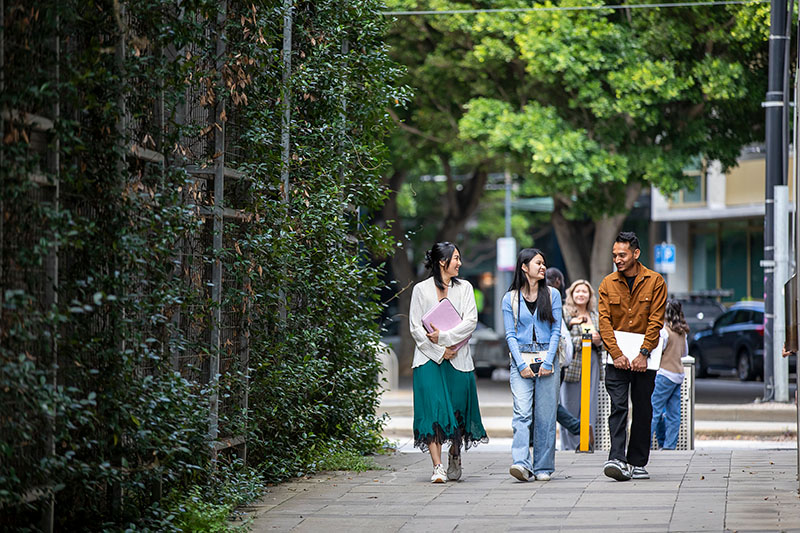
Here are 7 ways to make new friends in your new city.
1. Attend orientation activities
Attending your orientation at your university or college will help you prepare for study and a chance to meet your classmates, Student Ambassadors and join a Peer Mentoring Program. Check out activities tailored for new international students. For example, in Sydney, there’s the Lord Mayor’s Welcome to International Students event or in Adelaide, there’s the Welcome Dinner Project, where you can meet locals over a delicious meal.
2. Be proactive in organising group plans
Organising fun activities is a great way to bring people together. If you’re having dinner at your apartment on a Friday night, you can invite people that you meet in class to come over. Or, if you’re going to the beach or having a picnic, you can arrange a get-together and introduce your new friends to each other.
3. Join a club, society or sports team
Every education provider has a range of different clubs, societies and sports teams that you can join to connect with people who have similar interests to you.
In each trimester at KBS, we hold events designed to be interactive and inspiring for all our students. They include guest speakers, expert panels, Kindness week and Multicultural Week.
4. Follow your interests to meet like-minded people
Do you like pop music, yoga or dancing? Have a look online to find out the events and classes that interest you. Meetup and Weekend Notes has suggestions of things to do in each capital city. It’s a great way to meet locals and make friends in a community where you already have something in common.
5. Form a study group
Studying together not only helps you learn, but it’s a great excuse to hang out. Why not form a study group with a few of your classmates? Arrange to meet once a week on campus or at a café, and studying will become a whole lot more fun.
6. Explore Facebook and WhatsApp groups
Social media platforms are another way to make connections in Australia. There are many different groups and events you can join.
7. Volunteer for a cause you care about
Finding an organisation or cause to volunteer for is a worthwhile way of giving back to the community, connecting with like-minded people and you can add the experience and skills you developed to your resume. To find volunteer opportunities, you can look at SEEKVolunteer, GoVolunteer or Vollie.
You may also enjoy: